




Braked vs Unbraked Trailers: Which Brian James Trailer Do You Need?
Braked vs Unbraked Trailers: Which Brian James Trailer Do You Need?
One of the first decisions you'll face when choosing a trailer isn't the size, the colour, or even the price — it's whether you need a braked or unbraked model. It sounds like a small technical detail, but it actually determines what you're legally allowed to tow, how the trailer behaves on the road, and which Brian James models are even an option for your vehicle. Here's everything you need to know before you buy.
What's the Actual Difference?
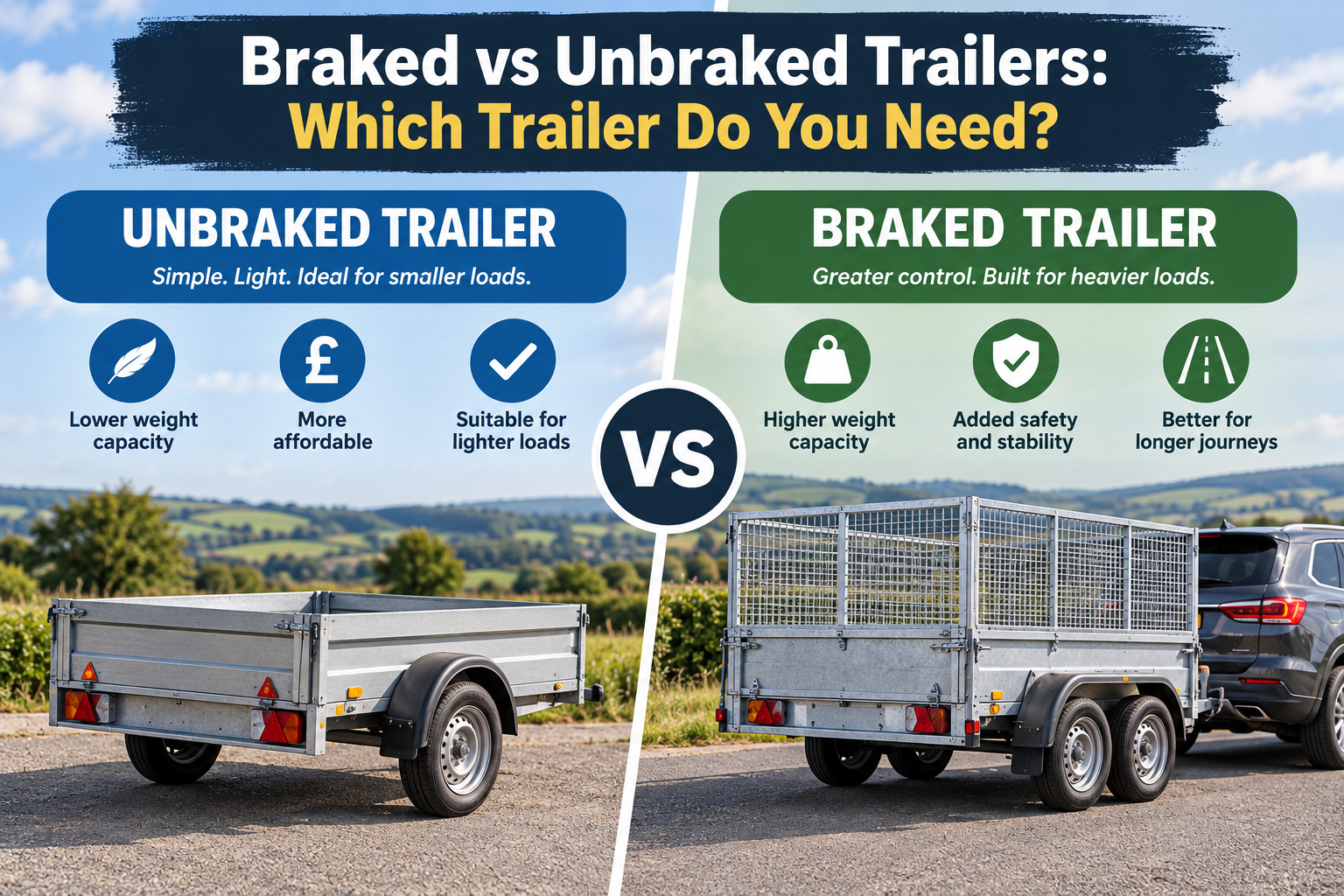
An unbraked trailer has no braking system of its own. When you slow down or stop, the towing vehicle's brakes do all the work — the trailer simply follows along behind, relying entirely on the tow car or van to bring the whole combination to a halt.
A braked trailer has its own brakes, almost always operated by an "overrun" or "override" coupling. As the tow vehicle slows, the trailer's momentum pushes it forward slightly against the tow ball, and this movement mechanically activates the trailer's brakes — no electrical or hydraulic link to the car is needed on most Brian James models. It's a simple, reliable system that's been used on trailers for decades.
The Legal Weight Limits
This is where the choice often gets made for you, rather than by you. Under UK law:
- An unbraked trailer must not exceed 750kg gross weight, or half the kerb weight of the towing vehicle — whichever figure is lower. So if your car has a kerb weight of 1,200kg, your legal unbraked limit is actually 600kg, not 750kg.
- A braked trailer can legally go up to 3,500kg gross weight (the maximum for an O2-category trailer), although in practice the real limit is whatever your specific tow vehicle is rated to pull — check your car's handbook or V5C, not just the trailer's plate.
In other words, once you're loading anything beyond a light general-purpose trailer — a car transporter, a tipper full of aggregate, or a mini digger — you're almost certainly into braked-trailer territory, both by law and by common sense.
Why It's Not Just About Legality
Even where an unbraked trailer is technically permitted, braking performance is a serious practical consideration. An unloaded, unbraked trailer might feel fine. But add a genuine load — a quad bike, a small car, a pallet of building materials — and stopping distances increase, the combination becomes harder to control under heavy braking, and any instability (known as "snaking") is much more difficult to correct without the trailer's own brakes helping to settle it.
This is exactly why Brian James builds the vast majority of its car transporter, tipper, flatbed, and plant trailer ranges as braked models fitted with reliable overrun braking systems. If you're regularly carrying vehicles, machinery, or heavy loads, a braked trailer isn't a luxury — it's the sensible, safer choice.
Which Brian James Trailers Are Braked?
As a general rule:
- Car transporters (open and enclosed) — braked as standard, given the weight of most vehicles being carried
- Tipper trailers — braked, since loaded weights routinely exceed unbraked limits
- Flatbed and Cargo/Connect trailers — available in both braked and unbraked configurations depending on the specific model and deck size, so it's worth checking the exact spec
- Plant/digger trailers — typically braked, particularly on anything designed for mini-excavators or larger compact plant
If you're only ever moving genuinely light loads — a small quantity of garden waste, a couple of bikes, light equipment under a few hundred kilos — a compact unbraked model may still make sense, and can be a lower-cost, lower-maintenance option since there's no braking system to service.
Don't Forget the Licence Side
Choosing braked or unbraked isn't just about the trailer — it also interacts with what your driving licence allows you to tow. As we covered in our previous article on driving licences and trailers, most car licence holders can now tow combinations up to 3,500kg MAM without a separate test, but it's always worth double-checking your entitlement and your vehicle's actual towing capacity before committing to a heavier braked model.
Getting the Right Match
The honest answer to "braked or unbraked?" almost always comes down to what you're actually going to carry, how often, and what your tow vehicle can handle. Buying too small a trailer means constantly bumping up against weight limits; buying more braked capacity than you'll ever use is an unnecessary cost.
At Eakin Bros, we can talk through exactly what you'll be transporting and match you to the right Brian James model — braked or unbraked — based on your vehicle, your licence, and the loads you actually need to move. Pop into our Maydown or Claudy branch, or get in touch with our team to find the right trailer for the job.