






UK Trailer Towing Laws and Weight Limits Explained
UK Trailer Towing Laws and Weight Limits Explained
Buying the right trailer is only half the job — using it legally and safely is the other half. There's a whole set of towing-specific rules around speed, road positioning, weight terminology, and how a trailer must be equipped. None of it is complicated, but it's easy to get caught out if you're towing for the first time. Here's a clear rundown of what UK law actually requires.
Speed Limits Change When You're Towing
The moment you hitch up a trailer, the national speed limits that apply to your car no longer apply in the same way. In Great Britain, the limits for a car towing a trailer or caravan are:
- Built-up areas: 30mph (same as normal)
- Single carriageways: 50mph
- Dual carriageways: 60mph
- Motorways: 60mph
These limits exist because a loaded trailer changes everything about how your vehicle handles — longer stopping distances, reduced stability under braking, and greater sensitivity to crosswinds and sudden manoeuvres. It's also worth remembering that Northern Ireland sets its own speed limits separately from Great Britain, so always check local road signage rather than assuming the GB figures apply automatically on every road.
The Motorway Lane Rule
If you're towing on a motorway with three or more lanes, there's one rule that catches people out constantly: you're not permitted to use the outside (right-hand) lane, except where road signs specifically direct you to due to lane closures. This applies regardless of how light the traffic is or how capable your tow vehicle feels — it's a straightforward legal restriction, not a recommendation.
Understanding the Weight Terminology
Trailer law is built around a handful of weight figures, and knowing what they mean makes everything else easier to follow:
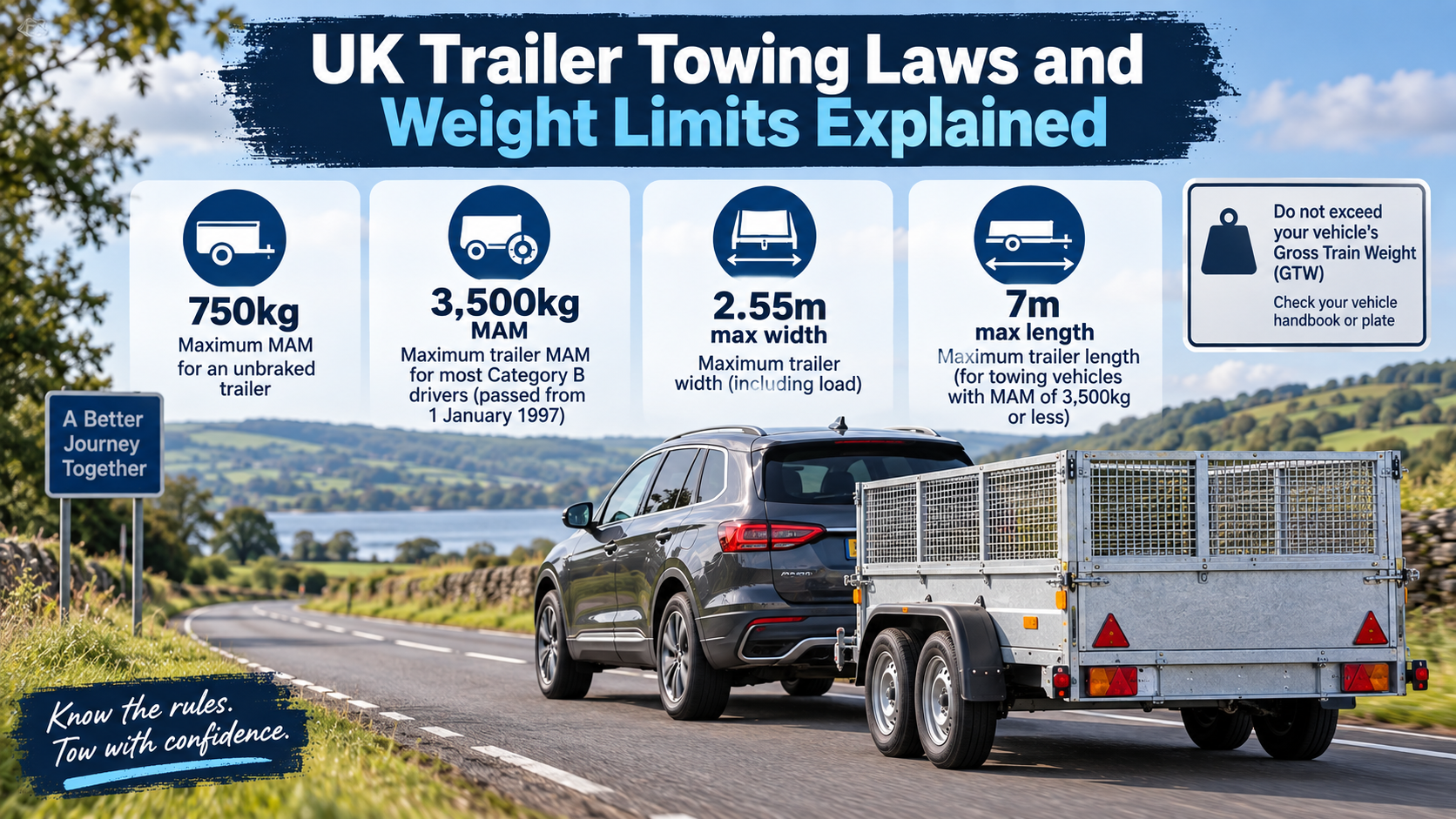
- MAM (Maximum Authorised Mass) — the maximum a trailer is legally permitted to weigh when fully loaded, stamped on its identification plate
- Kerb weight — your tow vehicle's weight including fuel and standard equipment, but without passengers or cargo
- Gross Train Weight (GTW) — the maximum combined weight of your car and trailer together, loaded, as specified for your specific vehicle
- Noseweight — the downward force the trailer's coupling exerts on your car's tow ball; too much or too little affects stability significantly and is usually specified by both the trailer and tow vehicle manufacturer
As we covered in our braked vs unbraked article, unbraked trailers are capped at 750kg or half your car's kerb weight (whichever is lower), while braked trailers can go up to 3,500kg — provided your vehicle's own towing capacity allows it. It's entirely possible for a trailer to be legally rated higher than your car can safely pull, so the car's handbook figure always takes priority.
Equipment the Law Requires
Every trailer on the road needs certain basics to be legal, regardless of size:
- A rear number plate matching the towing vehicle's registration
- Working lights — indicators, brake lights, and rear lights, all clearly visible
- A secondary coupling (safety chain or breakaway cable) so the trailer stays attached if it separates from the tow ball
- A weight plate clearly showing the trailer's maximum gross weight
- Red reflective triangles on the rear, and amber ones on the sides for larger trailers
Braked trailers additionally need functioning overrun brakes, and any trailer close to or exceeding 3,500kg unladen with powered braking systems may fall under DVSA's annual testing regime — something we cover in more detail in our trailer maintenance guide.
Loading and Securing Your Load
The law is clear that responsibility for a load sits with the person towing, not just the trailer manufacturer. Loads must be secured so they can't shift, fall, or become a hazard to other road users, and weight should be distributed evenly, with heavier items positioned low and towards the trailer's axle rather than overhanging at the rear — an unevenly loaded trailer is one of the most common causes of snaking and instability at speed.
Insurance Is Worth Checking Too
Trailers themselves aren't required to be separately insured in the same way as a car, but it's essential to confirm your car insurance policy covers you while towing, and that any goods or equipment being carried are covered under a separate policy if needed — particularly for business use.
Getting It Right From the Start
Towing law isn't designed to catch people out — it exists because a trailer fundamentally changes how a vehicle behaves on the road, and the rules reflect that. Getting the basics right from day one means fewer surprises, whether that's from a passing police check or simply from towing with real confidence.
If you're unsure whether a particular Brian James trailer suits your vehicle's towing capacity, or want a full walkthrough of what's legally required before you tow for the first time, our team at Eakin Bros is happy to talk it through. Pop into our Maydown or Claudy branch, or get in touch before you hit the road.